Showing posts with label Great Blue Heron. Show all posts

Thursday, May 4, 2017

Middle Creek (4-Mar-2017)


I had never been to Middle Creek Wildlife Management Area during the annual waterfowl migration. More than a couple people told me it was a sight to see and when I found out Rick Wiltraut from Jacobsburg Environmental Education Center was running a program there, I had to go. Most of the group drove down with Rick from Jacobsburg and some of us met them there. For me it was closer just to drive to Middle Creek. Above Rick is starting the program in Middle Creek's Education Center. He explained the importance of the Management Area and went over the species that we might come across while taking the tour. From the center it was down to the water! 


Tundra Swans were the first thing I saw. There large size and numbers at the first stop drew me right to them even though there were other birds around. Much of the management area has restricted access, but there are a few places, like this roadside stop where you can get up close to the birds. In total just off the road I would estimate that there were over a hundred Tundras that could be seen. 


These are shots of the group closest to the road. In the photo on the right you can clearly see the size difference between a Tundra Swan and a Canada Goose.


There were many good flybys throughout the day that started with this Great Blue Heron. Over the winter I do not get to see to many of these. Most migrate out of my area during the cold months.


A Canada Goose coming in for a landing. We did see a lot of Canadas on the water, but no where near the numbers of Tundra Swans and Snow Geese.


A small group of American Coots were swimming and feeding close to the road. None of the birds seemed to mind all of the people standing on the side with cameras, scopes and binoculars. 


The group from Jacobsburg taking in all of the birds. As you can see everyone is bundled up. Temperatures which had been unusually warm dropped sharply and it felt like we were thrown back into winter. 


At a stop on the driving tour of the management area, we had our closest look at Northern Pintail flying over head. 


At the same stop as the Pintail I got my favorite photo from the trip. Three Tundra Swans went right overhead!


The main flock of Snow Geese were on a smaller pond in a restricted area. Here the group is getting a very distant look at the birds that numbered in the tens of thousands. 
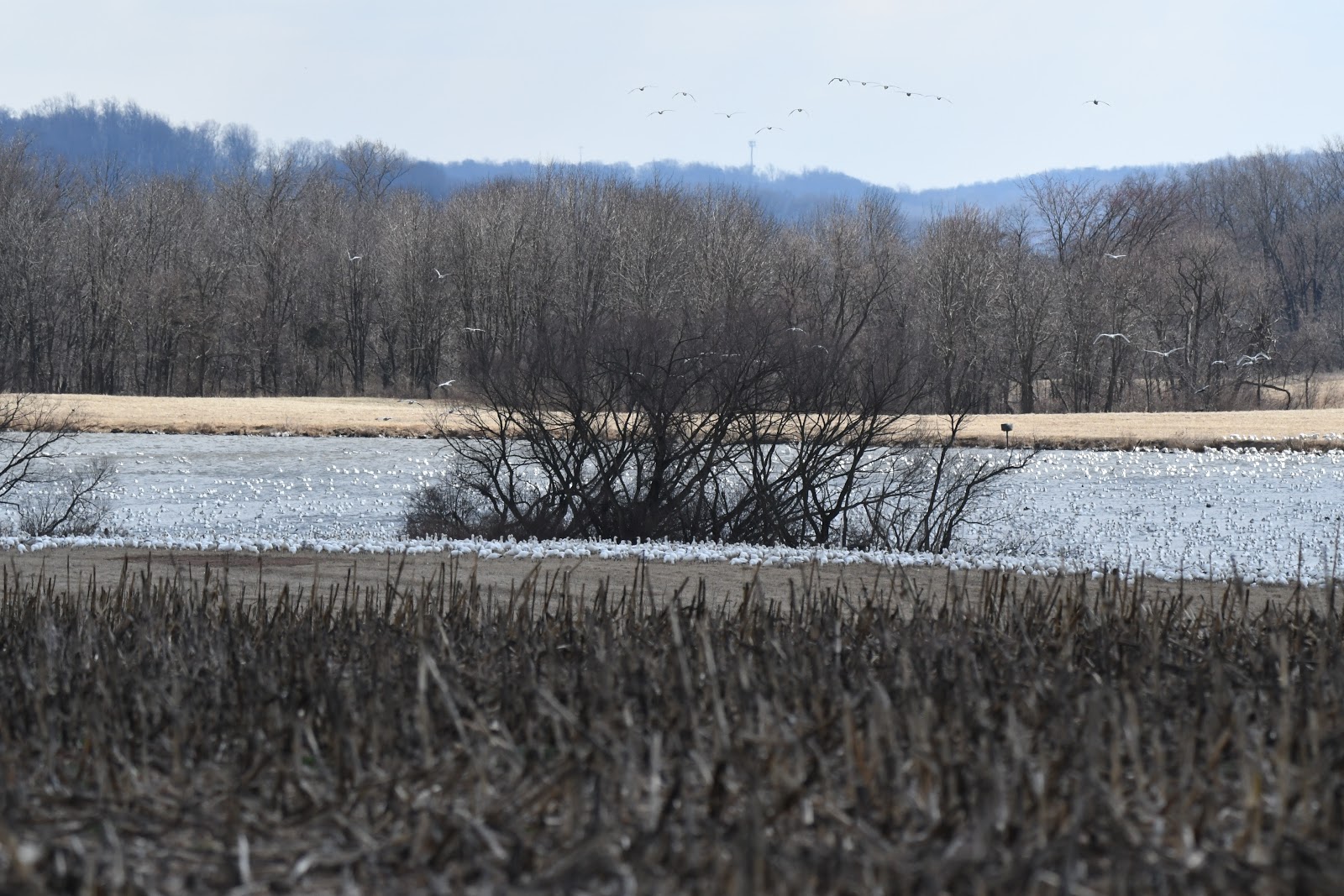

The geese blanketed much of the pond and some of the surrounding fields. This was really the best look we had at them all day. 


This Snow Goose was all alone in a field. It looked as though it may have a wing issue. With so many geese in one area there are bound to be some that get injured. If this goose couldn't fly, it most likely fed some of the other local wildlife.


As a result of the cold snap we weren't seeing as many species as we had hoped so the group decided to start heading back and bird another location where recently a rare bird had been sighted. Tyler Sacks and I did one more walk to a point on the lake before leaving. I was happy I stayed. Going out to the point we found the main group of Tundra Swans! There had to have been around a thousand! After walking back, both Tyler and I decided to try to catch up with the group.


We did find them and although we did not see the rare bird we were looking for we did make a stop to see a common bird with a rare coloration. This is a wild leucistic Red-tailed Hawk. It is amazing that this almost entirely white bird survived into adulthood and seems to be doing well. 


From this view you can see some red in the tail feathers. It was a cool bird to see and it was awesome that it flew towards us when we stopped. For such a cold day this was a great program. If you would like to see other programs Jacobsburg Environmental Education Center offers throughout the year you can visit: Jacobsburg's Calendar of Events.

See my most updated posts on Facebook: Taking Out the Trash in Eastern PA

Tuesday, October 25, 2016

Out of State Post: Chincoteague, VA Wildlife (14/16-Oct-2016)


I hope that you enjoy this post even though it isn't about removing trash from the environment nor were the photos taken in Eastern PA. It is about wildlife though, the main reason I go out and do clean-ups. On this trip I was able to see and photograph several species I had never come across before. The first was the immature Forester's Tern above. Several were sitting on the bridge to the National Wildlife Refuge. 


This was the second mammal my friends and I came across in Chincoteague. We first saw White-Tailed Deer the night before. This is not a White-Tail and isn't even a species native to the United States. This is a Sika and is more closely related to our Elk than to Deer. Sika were released on the island a very long time ago and now have an established population here. 


Like the Sika, Ponies are also an introduced species. From what I have read from the National Parks Service, it is unknown when the Ponies actually arrived on the island, but it was hundreds of years ago. The population on Chincoteague is monitored and managed, keeping the population between 150 and 160 individuals. Once a year all of the ponies are rounded up and some are sold as a way to control the population size. On nearby Assateague island, a separate population of about the same size is managed differently and ponies are given a form of birth control. 


These were two common sights along the roadway in the refuge. On the left is a Great Blue Heron and on the right is a Snowy Egret. I wonder if any of the Great Blue's I saw were ones I have passed on Pennsylvania rivers?


For this photo you may have to click to enlarge. Near the center is a Magnolia Warbler. This was another bird I got to add to my life list. 


On the ocean's edge Sanderlings were a common sight. This individual was foraging for food in the surf. 


Okay, so this isn't a live Horseshoe Crab, I liked the way the photo came out though. As I stated in the last post, there were lots of dead Horseshoe Crabs washed up along both the ocean and bayside.


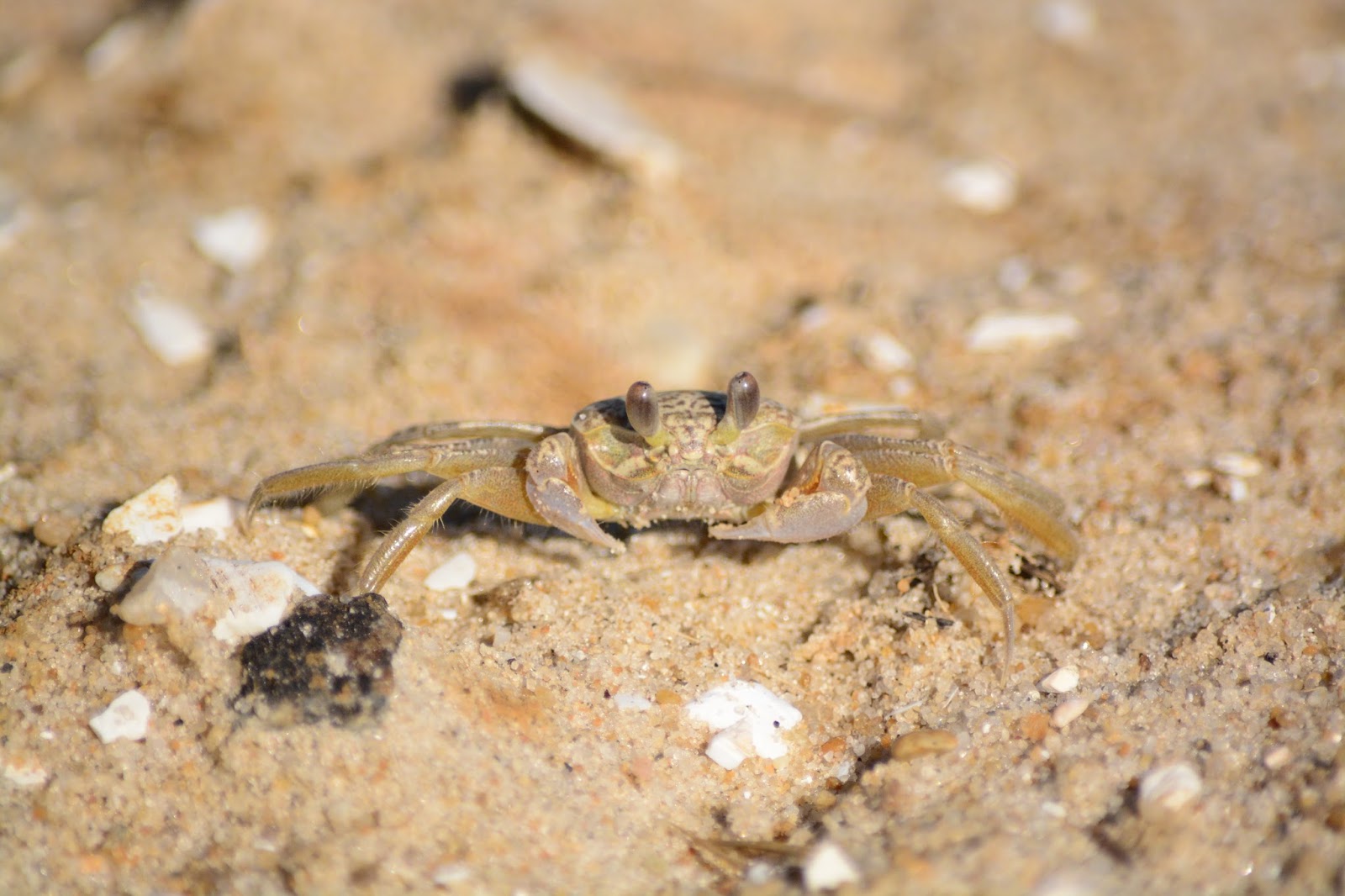
Very hard to spot, on and around the dunes there were many Ghost Crabs. For me they were impossible to see until they started moving. In the tidal areas I did also see Fidler Crabs, no good photos of those though. 


I was pretty sure I would see bird species I had never seen before on this trip, but I didn't think I would see a new butterfly species. This is a Common Buckeye and there were lots of them in the refuge. What amazing coloration and eye spots!


A Semipalmated Plover, another new species for me. It was hanging around a couple Piping Plovers. 


This Turkey Vulture ignored me as it flew in to some bones on the beach. I often see these in PA, I still thought it was neat seeing it feeding on the sand. 


This was not the first time I had seen American Oystercatchers. They were still awesome to see again. 


A group of Dunlin flying to feast on critters in the newly exposed sand from the tide going out.


This is something that I associate with manmade farm fields and quarries. Snow Geese to me just seemed out of place on the bayside. This is where their natural migration route takes them though. 


From a distance I thought there were just two Black Backed Gulls on this pier. As I got closer I realized they were not gulls, but Bald Eagles! 


When the tide went out I was able to see a few invertebrates that were exposed by the lower water. I can not say much about them, on the left is a species of saltwater snail and on the right a species of tube worm. The Tube worms had really cool tubes crafted out of shells and aquatic vegetation. 


You may think these are both Jellyfish. The one on the left is. The one on the right is a little more complex. It is called a Portuguese Man-Of-War and it is not just one organism. It uses the air filled balloon as a sail and drifts on the ocean surface. Tendrils hang down from the bottom of the balloon and catch prey items as it drifts. If you would like to learn more about the Portuguese Man-Of-War I would suggest visiting National Geographic's page on it. They give a good explanation of what it actually is.


The bird near the center is a Piping Plover. According to the US Fish and Wildlife Service in 1986 with only 790 breeding pairs on the Atlantic Coast the Piping Plover was placed on the Endangered Species List. Since then efforts to help increase their populations have worked and the number of breeding pairs is double that of thirty years ago. Their status has been reduced to Threatened, but their numbers are still no where near what they once were.


I tried very hard to get a good photo of a Delmarva Fox Squirrel. That did not happen and this was the best I could do. The Delmarva Fox Squirrel is a subspecies of the Fox Squirrel and only occurs on the Delmarva Peninsula. According to the US Fish and Wildlife Service until recent years it made our nations list of Endangered Species. Due to recovery projects this subspecies rebounded to the point it was completely delisted. Still it is only found in abundance in specific places on the peninsula and does not have a widespread range. 


This isn't a Fox Squirrel, I still think it's cool though. This black Grey Squirrel was on the Island Nature Trail in a township owned park. This is only the second black Grey Squirrel I have ever seen. 


In the same township park I got to see another new species for me. This is a Brown-headed Nuthatch. This was our third stop to try to see this species and I am glad it was there. 


My last view of the Wild Ponies before leaving. This was the most I saw in one place on the entire trip.

I would like to give a special thanks to Joe Greco who invited me along and pointed out and identified most of the new bird species I added to my life list! Also, thanks to Tyler Sacks who helped pick litter off of the beaches as well! 


You too can help with taking out the trash! If you get out hiking take a grocery bag with you, give it a second use and fill it with trash while you are out! Every bit helps. You can also help contributing to this project here: Help Fund Taking Out the Trash

Like this project? Like it on Facebook: Taking Out the Trash in Eastern PA

Thursday, June 16, 2016

Lehigh River (15-June-2016)


The second half of the trip I already had a bag of recyclables to take back which limited what I could take off the river. Before getting out on the water I walked the bank and collected several plastic bottles you can see piled up next to the boat. Also grabbed some non-recyclabes and took them up to the can by the parking area. Then it was off on the water. I decided because of my already limited space I would focus on recyclables going down the river.


I kept river left and hugged the bank which had lots and lots of plastics. Next trip down I will do the same, but on river right. 


Floating in the water I found the only river beer of the trip and a Jitterbug lure. The beer was poured out and the Jitterbug went into my dry bag.


This raft or air mattress was floating along the side and I thought why not? Then dragged it out of the water, pulled the plug and let it drain out while I cleaned what looked to be a campsite and down the bank. After it was emptied it folded up and fit nicely on the front of the boat.


Found three basketballs fairly close together on the bank and of course I had to take them. All were in good shape and will most likely see use again.


Near the end of a string of islands I decided to get out for a walk and stretch. By this point including the canal I had spent about seven hours sitting in the kayak. I wanted to get back before dark, but I needed a break from sitting. 


When I set out on the water again I passed this mother Merganser and young sitting on a rock. I see Mergansers on almost every river trip and I never get tired of seeing them. 


When I saw this inner tube caught in this strainer I didn't think it would be a problem to take. It ended up being a family size tube with hand grips for four or more people. It also had mud lodged in its folds. The size and weight not only made it difficult to get over the bow of my kayak, but then made it hard to paddle. It also hung over both sides creating drag, this made for a slow paddle to the end. The good news was the end wasn't far away.


Getting close to the take out I spotted the only Great Blue Heron of the trip. Normally there would be more on this section. I may have just missed them, it was good to see this one before the end. 


Pulling into the launch I interrupted a couples engagement photos. I somewhat felt bad, but I also paid for my launch permit. None of them had one and were using the launch. Hauling everything up was quick and I was happy for the end of the long day. 


The bag on the far left was full of recyclables from the canal, everything else came from the river. There was also recyclables still in the back hull of the kayak. I think for the entire day canal included this ended up being a great clean-up. I will be back to this location on Friday to take out more trash!
You too can help with taking out the trash! If you get out hiking take a grocery bag with you, give it a second use and fill it with trash while you are out! Every bit helps. You can also help contributing to this project here: Help Fund Taking Out the Trash

Like this project? Like it on Facebook: Taking Out the Trash in Eastern PA