
As I have stated in previous posts, the Northampton County Junior Conservation School is a one week residential summer camp for ages 14-17. The week includes a variety of programs which take the participants out into the field to learn about different conservation related topics of study. I was a student in 2000 and have been helping with the program for the past 16 years. The highlight for me is always the canoe trip and river clean-up. The past several years, during the week of camp, the conditions on the Delaware were unsafe, meaning the river was flowing too high and fast to safely navigate. Because of this we had to instead paddle either the Lehigh or Longpond. This year the conditions were perfect on the Delaware and we were able to return for a large clean-up. If you are familiar with the Delaware and are looking at the photo above you may be thinking... "that's not the river." and you would be correct. Before taking the students out on moving water the Conservation School first teaches boater water safety on a lake.

This year the water safety was preformed on Lake Nockamixon in Nockamixon State Park. Here the students learned first through lectures on shore, then had to prove they could swim 300 yards while wearing a personal floatation device (PFD) and then had to demonstrate what they had learned in the lecture on the water. By the end the students showed they can enter and exit a canoe safely, were able to steer, follow paddle signals, follow whistle signals and preform a boat over boat rescue with canoes. In this photo Tyler Sacks is preforming a boat over boat rescue with one of the students. This year all of the students did an excellent job and showed they were ready for the river!


Along the river the education doesn't stop. Do you know what this building along the Delaware is? The students can tell you it is the Merrill Creek Pumping Station. It has the ability to discharge large volumes of water into the Delaware from the Merrill Creek Reservoir during times of extremely low water in the river. Why would this be needed you ask? There are two nuclear power facilities in Salem, New Jersey, both draw their coolant water from the Delaware. If the river is not high enough, there is not enough coolant for these facilities and that can lead to a substantial problem. Merrill Creek is just part of an array of reservoirs that can be utilized to raise the river levels to the needed depths for the coolant processes to continue at these facilities. This is something that every citizen of PA or NJ should know about, but few do. This photo was taken on the preliminary and not on the NCJCS trip.

Throughout the two day trip the students stopped when they saw trash. There were a few sections where they were instructed to keep on paddling due to time or hazards, but other than those they did a great job of sticking to the second goal and removing the things that don't belong on our riverbank.
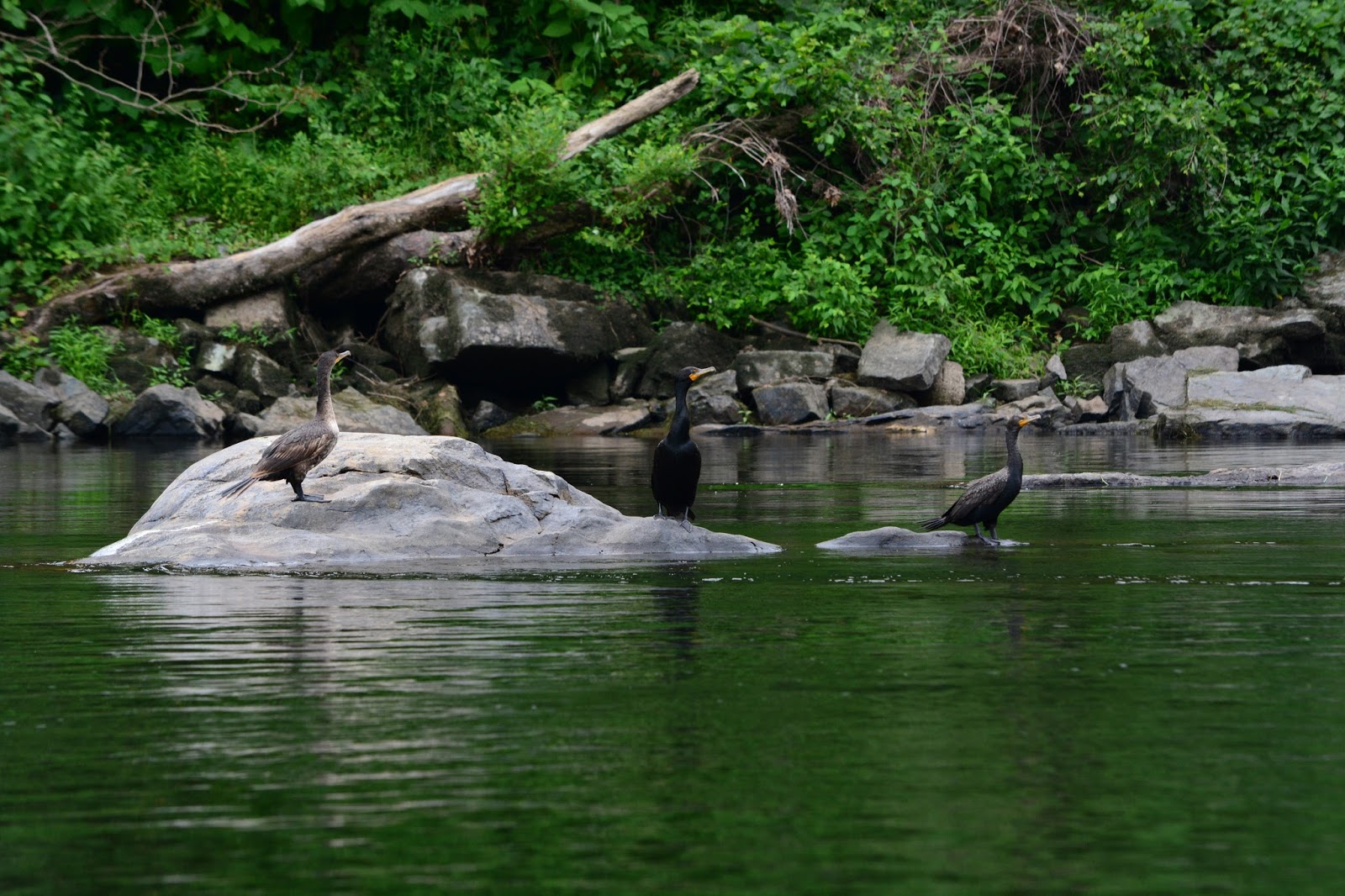
There were four Cormorants on these rocks just above Phillipsburg on the New Jersey side of the river. These three stuck around as all of the canoes paddled by. Most of the time Cormorants fly when you get anywhere near them on the river. The three above must either be used to boats passing by or just like the real-estate enough that they didn't want to leave.

Environmental educator Rick Wiltraut holds a Common Map Turtle. Rick and two other staff members from Jacobsburg Environmental Education Center were along for the trip. In addition to removing trash along with us, they pointed out and talked about wildlife as we came across it on the river. Special thanks to Rick, Andy and Cory for your help!

Nearing the boat launch in Easton for lunch. In the front of the boat is Cameron, a student and my canoe partner for the trip. He did a great job not only paddling, but picking up trash as well.

After lunch it was only a short distance down river to the campsite for the night. On the way there I spotted this fawn on one of the pillars to the 78 bridge. Don't worry it could easily get up the bank on the other side and was not trapped. Just past the bridge we all secured our trash filled canoes on the riverbank and headed up to Wi-Hit-Tuk Park for the night.

At Wi-Hit-Tuk, Steven Kloiber stopped by to do an entomological presentation on moths. He brought with him a vast array of pinned specimens and set up a sheet with light to attract moths and other insects in the area.


The sheet did not attract as much as we had hoped for being down by the river, still a variety of insect species came in, including moths and some aquatics like the Giant Stonefly on the left.

Staff members playing calls were also able to bring in five Eastern Screech Owls to the camp site. They did not stick around in one place long and this was the only one I was able to photograph.

Back on the water the next morning. I spotted two green pieces sticking up out of a small strainer near the end of the island near Wi-Hit-Tuk. To my surprise it was the largest turtle I have ever caught anywhere. It could also be filled with sand. It was missing its carapace though.

At another island we stopped for the next educational lesson. Rick and Andy from Jacobsburg gave a short lecture on macroinvertebrates and the students then waded into the river to find some. They were taught how macros are used to determine water quality and used an index to figure out how the water in the Delaware compared to a stream they had sampled earlier in the week. Once the macro program was over we were back on the water.

I spotted this on the preliminary run and head staff member Thomas Figel went along with me to try to get it on this trip. We thought it would be easy, but we quickly learned this slide was broken and filled with sediment. The two of us couldn't even lift it up onto the rock next to it. I have to say I was disappointed we couldn't get this off the river.

Another staff member Ryan found this when going for other trash. I helped him dig it out only to find there were large roots growing through it. Ryan was able to cut the plastic shell and we did get it out of there. The parts may have not gone together originally, but I was leaving the river with a full sandbox turtle!

It was close enough to a match.

Andrew had just about the most impressive rig on the river for this trip. He definitely had the most tires.

You too can help with taking out the trash! If you get out hiking take a grocery bag with you, give it a second use and fill it with trash while you are out! Every bit helps. You can also help contributing to this project here: Help Fund Taking Out the Trash
Like this project? Like it on Facebook: Taking Out the Trash in Eastern PA


