Showing posts with label Jacobsburg Environmental Education Center. Show all posts

Thursday, May 4, 2017

Middle Creek (4-Mar-2017)


I had never been to Middle Creek Wildlife Management Area during the annual waterfowl migration. More than a couple people told me it was a sight to see and when I found out Rick Wiltraut from Jacobsburg Environmental Education Center was running a program there, I had to go. Most of the group drove down with Rick from Jacobsburg and some of us met them there. For me it was closer just to drive to Middle Creek. Above Rick is starting the program in Middle Creek's Education Center. He explained the importance of the Management Area and went over the species that we might come across while taking the tour. From the center it was down to the water! 


Tundra Swans were the first thing I saw. There large size and numbers at the first stop drew me right to them even though there were other birds around. Much of the management area has restricted access, but there are a few places, like this roadside stop where you can get up close to the birds. In total just off the road I would estimate that there were over a hundred Tundras that could be seen. 


These are shots of the group closest to the road. In the photo on the right you can clearly see the size difference between a Tundra Swan and a Canada Goose.


There were many good flybys throughout the day that started with this Great Blue Heron. Over the winter I do not get to see to many of these. Most migrate out of my area during the cold months.


A Canada Goose coming in for a landing. We did see a lot of Canadas on the water, but no where near the numbers of Tundra Swans and Snow Geese.


A small group of American Coots were swimming and feeding close to the road. None of the birds seemed to mind all of the people standing on the side with cameras, scopes and binoculars. 


The group from Jacobsburg taking in all of the birds. As you can see everyone is bundled up. Temperatures which had been unusually warm dropped sharply and it felt like we were thrown back into winter. 


At a stop on the driving tour of the management area, we had our closest look at Northern Pintail flying over head. 


At the same stop as the Pintail I got my favorite photo from the trip. Three Tundra Swans went right overhead!


The main flock of Snow Geese were on a smaller pond in a restricted area. Here the group is getting a very distant look at the birds that numbered in the tens of thousands. 
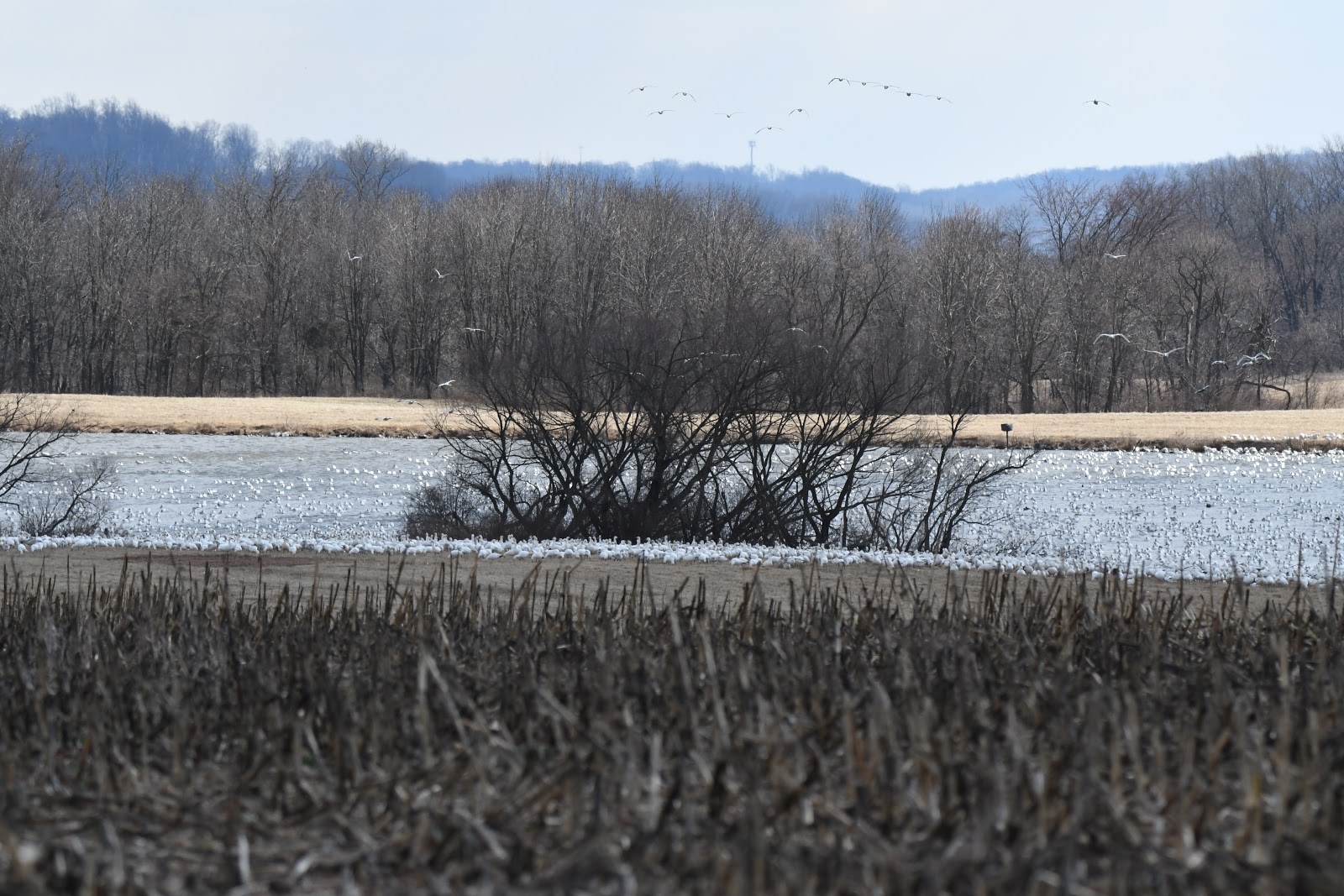

The geese blanketed much of the pond and some of the surrounding fields. This was really the best look we had at them all day. 


This Snow Goose was all alone in a field. It looked as though it may have a wing issue. With so many geese in one area there are bound to be some that get injured. If this goose couldn't fly, it most likely fed some of the other local wildlife.


As a result of the cold snap we weren't seeing as many species as we had hoped so the group decided to start heading back and bird another location where recently a rare bird had been sighted. Tyler Sacks and I did one more walk to a point on the lake before leaving. I was happy I stayed. Going out to the point we found the main group of Tundra Swans! There had to have been around a thousand! After walking back, both Tyler and I decided to try to catch up with the group.


We did find them and although we did not see the rare bird we were looking for we did make a stop to see a common bird with a rare coloration. This is a wild leucistic Red-tailed Hawk. It is amazing that this almost entirely white bird survived into adulthood and seems to be doing well. 


From this view you can see some red in the tail feathers. It was a cool bird to see and it was awesome that it flew towards us when we stopped. For such a cold day this was a great program. If you would like to see other programs Jacobsburg Environmental Education Center offers throughout the year you can visit: Jacobsburg's Calendar of Events.

See my most updated posts on Facebook: Taking Out the Trash in Eastern PA

Friday, March 17, 2017

Winter Bird Count 2017 (14-Jan)


The Winter Bird Count is an annual event held by Jacobsburg Environmental Education Center. Around the same time every year, Environmental Educator Rick Wiltraut, collects data on the birds species found within a five mile radius of the education center. He and volunteers collect this data over a weeks time and on one of the days the public is invited along to join in the count. I and several others have participated in this event since its start and every year it ends up being a great day of birding! At the end of this post I have included a link to Jacobsburg's upcoming events if you too want to join Jacobsburg's staff in getting out and having some fun learning. 


At one of our first stops, within Jacobsburg State Park, this Pileated Woodpecker gave us a fairly close flyby. Pileated Woodpeckers are our largest species of Woodpecker in the United States. 


Stopping at Nazareth Park, we got a close look at this male Yellow-Bellied Sapsucker. If you look closely at the tree trunk you can see the holes that the Sapsucker has drilled into the tree. They generally make a vertical line of these holes and then several lines at different levels of the tree. As you watch them they will move from line to line, hole to hole lapping up the sap that is draining from them.


A Northern Mocking Bird in Nazareth. This is a very common bird in Eastern PA. Its name comes from its ability to mimic other bird calls. I have heard some do a pretty impressive Red-Tailed Hawk call. 


This is a Chickadee species. I cannot definitively say weather this is a Black-Capped or Carolina Chickadee because they look nearly identical. In the past only Black-Capped Chickadees would have been found in this area and the Carolina's were found further south. It is hypothesized that the Carolina Chickadee range is moving further north due to global climate change. Collecting data from counts like this can help researchers in showing range movements like that of the Carolina Chickadee and other species which ranges are expanding or getting smaller.


At the same stop as the Chickadee, this White-Breasted Nuthatch struck an awesome pose for me to snap a shot. Many times you will find different bird species flocking together. This is called a mixed species flock. Often each species has a different niche or different method of feeding. So although the different species are flocking together they are not competing over the same food source. You can see examples of this at your own backyard feeders. Some birds like Juncos will tend to stick to the ground, where other birds like Downy Woodpeckers will prefer hanging suet feeders. Both occupying the same area at the same time, but feeding off of different sources. The thought is that these mixed species flocks offer these species safety in numbers, more eyes to look out for predators.


Back at Jacobsburg we got to see more than one Purple Finch feeding on red berries. Purple Finch's can be confused with an introduced species the House Finch. The above is definitely a Purple Finch. 


As we continued on to our other count stops snow started to fall. The group that was along was ready and willing to bird in the snow and cold!


At this particular stop some of use stayed close to the van while others trekked down a trail to try to add a Catbird that had been hanging out in the area for awhile. Those who made the walk were able to see it. 


Only feet from the van someone spotted two Brown Creepers working their way up a tree. This is one of them, you may have to stare at the photo a minute before you see it. For all of the photos if you would like to see them enlarged you can click on them. 


The group pressed on through the storm and headed to the Waste Management's Grand Central Sanitary Landfill in Pen Argyl. We were met by a representative from Waste Management who walked us out to the active part of the landfill. With it being a weekend there was no new trash coming in but there were definitely birds!


Gulls are a common sight at landfills, most of the time it is just Ring-Billed and Blackback Gulls. That is all that we found and Rick was really hopeful for an Iceland Gull.


This is a Fish Crow. Like the Chickadees I mentioned earlier, Fish and American Crows are nearly identical to one another. There is an easy give away between these two species though. The calls of these species a very different and both like to vocalize. We did see and hear both Fish and American Crows at the landfill, this one was a Fish. 


There was a large flock of starlings picking through the trash. This one was taking a rest on something sticking up. Starlings are an introduced species here in the US. Originally from Europe they have established large populations here. I personally find them a nuisance. 


As the rest of the group started our way back to the van, our valiant guide kept scanning for an Iceland Gull. There is often one mixed in with the thousand or so other gulls. To his credit, Rick did go back and did spot the Iceland Gull a couple days later to add to the list. 


Here Andrew Curtis (scope) and Tyler Sacks (binoculars) are scanning a flock of Horned Larks to see if they can spot any other species mixed in. This stop at a dairy farm was one of the last of the day. Horned Larks are often found in fields around dairy farms because the manure from the cows is spread over the field. You may have guessed it, the larks forage through the manure to find food. 


If it hadn't snowed we probably would only have seen a few of these larks. Their coloration allows them to blend into a field quite well. I have never seen so many in one place before and this photo is only a portion of the whole flock. It was estimated that there were about five hundred in this one field. 


This photo is cropped down and the birds are a bit fuzzy. If you look closely towards the center though you can see why I cropped it. One of the birds in flight is different from the rest. It is a Snow Bunting! The first one I have ever photographed. I still can't say I've ever seen one, but I managed to snap a shot!


The snow made us stop the count short of a full day. The road conditions were beginning to deteriorate and I don't think any of us participating minded calling it a day. 


I tried to at least pick up something at every stop. Some of the participants joined in as well and added to my pack full of trash. By the end this is what I had. I didn't sort it out like I normally do for the photo. I had a long ride home and conditions weren't getting any better, so I was in a hurry. 


Jacobsburg Environmental Education Center, located in Northampton County, provides educational public programs year round. Most are free! You can find there current list of events here: Jacobsburg Environmental Education Center Programs This list is updated throughout the year.

See my most updated posts on Facebook: Taking Out the Trash in Eastern PA

Wednesday, July 6, 2016

Jacobsburg Environmental Education Center (6-July-2016)


I haven't been out the past couple days because of the amount of people on the river and in the local parks due to the extended holiday weekend. I have also been preparing for the Northampton County Junior Conservation School. NCJCS for me started tonight with prep work with other volunteers at the location it is held. It is near Jacobsburg Environmental Education Center so I left early enough to go do a small clean-up before going to help with set-up for the camp. It has been some time since I have hiked the trails at Jacobsburg and I really did not know what to expect. 


Walking into Henry's Woods, was pretty much the same, with the exception of some large trees. Years ago this small portion of forest called Henry's Woods was defined by a small patch of old growth Eastern Hemlocks. Now very few of the giants still stand here. The Eastern Hemlock is our state tree and is currently facing the problem of an alien invader. The non-native Hemlock Wooly Adelgid has been attacking our Hemlocks for many years. In some places the infestations have caused die offs of Hemlocks and the Adelgids have proved hard to get rid of. In the case of the old growths at Jacobsburg, I believe most fell due to storms baring heavy winds on the tall trees and not due to the Adelgid, although these trees too were infested. 


This was next to the stream side in an area that gets a lot of use by families. I wonder how many parents saw this, walked their children around it and felt it acceptable to just leave there. I wonder a lot about how people see litter and do nothing about it. I see a lot of evidence of people not caring about others or the environment. It does get tiring. 


The first, but not the last bag of dog feces I found discarded along the trail. I have a dog, I pick up her waste and I dispose of it properly. It is not hard and there is no excuse for someone throwing it off of the trailside. If you have a dog, it and what it makes is your responsibility. Please if you ever see someone throwing bags like this off the trail, ask them kindly to pick it up. I do not enjoy picking up others dog waste. 


This is what I was hoping not to see. Since my last visit more trails have popped up that lead down to the stream. It doesn't take much to ruin an area. The photo on the left is one of the new trails and the photo on the right is what that area would look similar to had someone not made a trail. These trails do have an impact on the stream. During rain events, more sediments end up in the streams and the banks generally start to have erosion issues. Also, the removal of plants that hang over the stream can end up raising the temperature of the water, which can be detrimental for both fish and macroinvertebrates. This can be prevented if people stick to the trails.


One of a few streams in Eastern PA called the Bushkill Creek. Another with the same name is just a county away. 


This was another thing that was disappointing to me. I could hear it and I found evidence that it went through, but I never did see it. Someone was driving an ATV through the park. I would like everyone to know that if you are caught on DCNR hiking trails with an ATV, your vehicle will be confiscated. I have seen a DCNR Ranger take a dirt bike before, so it does happen. 


The first pile was from the Henry's Woods Trail and the other was just from a short walk by the stream across from the main office. I didn't take many photos from the second walk. I really did not collect that much, but as always there shouldn't even be this much in our parks.


I noticed several of these on this excursion. This is a female Gypsy Moth in the process of laying eggs. The orange coming from underneath the moth is the egg casing. Gypsy Moths are non-native and in their larval stage can completely defoliate trees, both deciduous and coniferous. The impact of the larval stage can lead to large tree die offs. Populations of this species are controlled by spraying efforts to try to prevent large scale die offs of forested areas. 


The only reptile of the walk. This Northern Watersnake look content sitting in the current. As I have stated many times in this blog, Northern Watersnakes are not venomous and are a beneficial part to our aquatic ecosystems. Please don't kill snakes, just give them distance and respect when you encounter one in the wild. 

This will most likely be my last post until the end of NCJCS on the 16th. I will be back with lots of photos and several posts from the week of camp and our trash collecting adventure on the Delaware!

You too can help with taking out the trash! If you get out hiking take a grocery bag with you, give it a second use and fill it with trash while you are out! Every bit helps. You can also help contributing to this project here: Help Fund Taking Out the Trash

Like this project? Like it on Facebook: Taking Out the Trash in Eastern PA

Tuesday, February 2, 2016

Upper Delaware Eagle Watch (30-Jan-2016)


On Saturday January 30th, Jacobsburg Environmental Education Center held an Eagle watching program on the Upper Delaware. It was an all day event running from 7am to a little past 8pm. I would like to point out once again that most DCNR educational programs are free. This one even included transportation from the Ed Center and one other location. Check with your local State Park to see what programs they offer and you may be surprised what you can see and learn about even locally. I snapped the above photo of the sunrise before we left the Ed Center.


The first stop of the day did have a Peregrine Falcon, but it was way off in the distance. The photo above is from the second stop of the day. Looking upriver there was a group of Goldeneyes, Mergansers and some non-native Mute Swans.


While we were standing at the riverside, this Merlin which is another one of our falcons came and checked the group out.


The group at our third stop of the day. This was one of the boat launches within the Delaware Water Gap Recreation Area. 


At a small pull-off we found our first Eagle's nest. In this case both occupants were home and peering out of their massive nest.


Before leaving the Eagle's nest site the group got a good look at a Yellow-Bellied Sapsucker. If you are having trouble seeing it you can click on the photo to enlarge the image. 


We made a quick stop at the main office of the Delaware Water Gap National Recreation Area and the group was kind enough to pose for this group shot by the wetland. 


On a ridge top two more Bald Eagles were spotted as we made our way driving up the Delaware. 


As we kept driving North through the Recreation Area there was less and less snow. At this stop, another boating access, I was able to pick up some trash. Like the last public trip, when I started others pitched in and helped! One nice thing about the Recreation Area accesses is that everyone has both trash and recycling bins making it really easy to dispose of everything picked up. 


This is Bill who volunteered to be a driver for the day. Not only did he volunteer to help the DCNR, but he removed this trash bag which was full of insulation! 


At a roadside pull-off away from the river, we didn't see any birds, but I did find trash. I really hope someone didn't change their oil there, but with finding the empty oil cans, most likely someone did. 


At the last stop in the Recreation area just a few items were found. Again, I wasn't the only one picking up and I was happy for the help. 


At this point we had not only left the Recreation Area, but Pennsylvania as well. We were now in New York State and still following the river upstream. 


As the sign reads this pull-off is called the Hawk's Nest. Some birds could be seen out on the horizon, but there was nothing close. Sadly a look over the edge revealed that many visitors dispose of their trash over the edge. This is not just an issue for those who live in New York, but any who live downstream. If not taken care of the trash will eventually make it to the river. 


At an Eagle watching station further upriver someone spotted something swimming across the river. It was two Beavers that climbed up onto a rock and stuck around for a couple photos.


Crossing back over the Delaware into Pennsylvania we got our closest look at a Bald Eagle in a Fish and Boat Commission parking lot. There was a crowd gathered before we arrived with cameras and spotting scopes out. This Eagle did not seem to mind. 


I decided to check out the boat launch at this access and in doing so found a lot of trash on the bank and in the water. I was really disappointed that it was here. The area clearly gets a lot of visitors that come to watch the Eagles, yet no one has bothered to clean up at all. With no trash cans around I went and got a trash bag and started filling it up. I didn't have much time so this was a dash for trash and I wasn't able to get a photo of everything collected before I had to go. This is definitely an area I will be back to and maybe sometime soon, since there wasn't much snow there and the ground is still covered here. 


We then followed the Lackawaxen River away from the Delaware. There across the river the group got to see one of the best sites of the day. Four Eagles in one tree. This photo only has three, one decided to take off before I could find an open view. 


On our way back I was able to take this photo of the sunset over Lake Wallenpaupack. In all there were 25 Bald Eagles and 1 Golden Eagle sited. It was a great day! For me it was great to see so many of a once endangered species along one of our local rivers! Thank you to all that participated and a special thanks to those who helped take out the trash!

You too can help with taking out the trash! If you get out hiking take a grocery bag with you, give it a second use and fill it with trash while you are out! Every bit helps. You can also help contributing to this project here: Help Fund Taking Out the Trash